Rules & Information
Track Guide
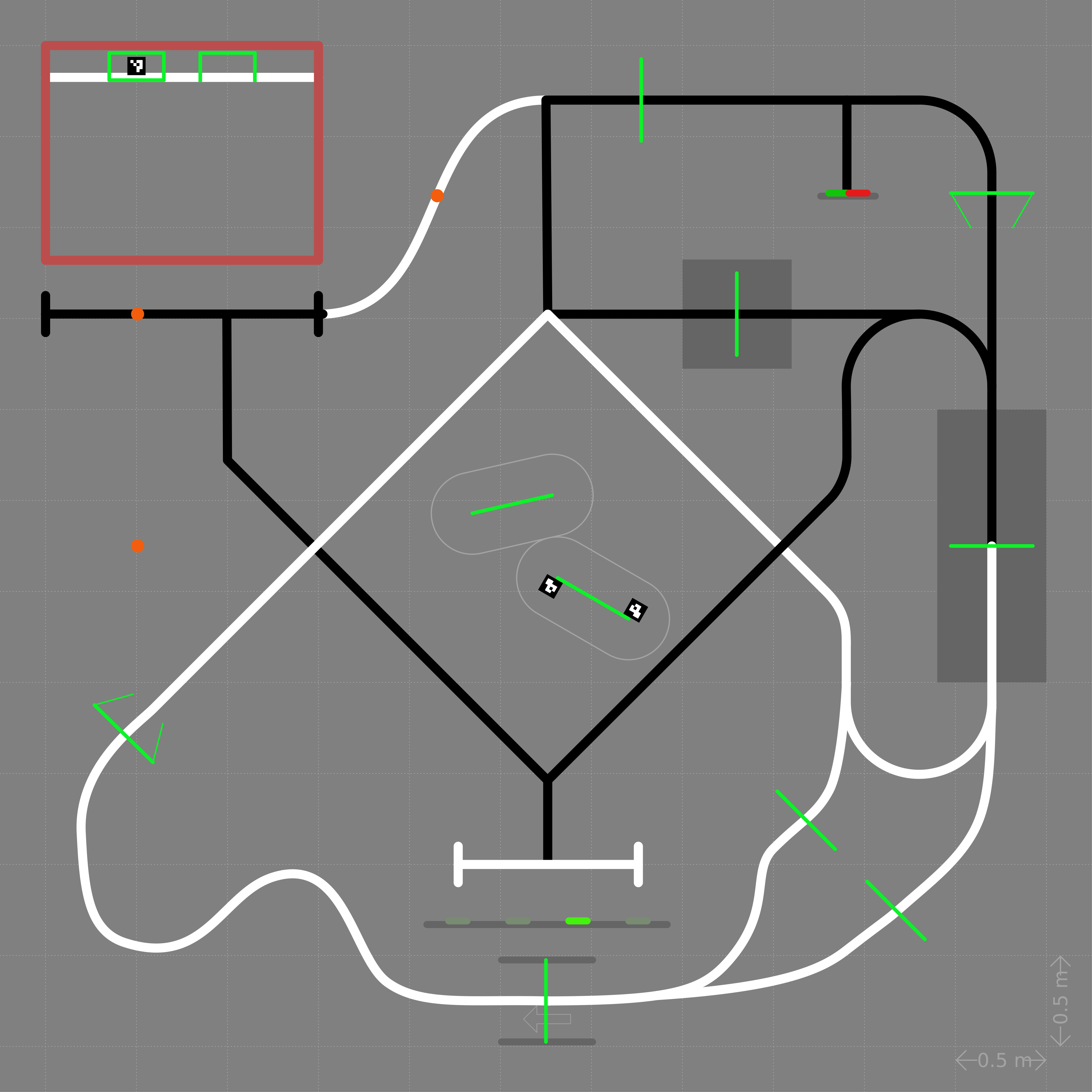
Explore the track or check the 3D simulation to understand the rules and obstacles for RoboCup.dk 2026.
1
2
3
3a
3b
3c
4
5
6
7
8
9
10
11
Explore the track
Select a point on the diagram to the left to view detailed rules, images, and point distributions for each sector.
Track Specifications
SurfaceBlue-gray linoleum
Gates
Internal dimensions (W×H) 450×480 mm
Plastic for 3D printing:
BallsOrange foam balls 40 mm
Buy here:AliExpress
The ball is slightly smaller than a golf ball and weighs approx. 3g.
3D obstacle models
Download:Onshape Robocup.dk 2026
The drawings are not final and will be updated continuously as the physical obstacles are manufactured.
The track layout is indicative. The exact placement of lines, curves, gates, etc. may deviate slightly from the drawing. All dimensions are indicative.
Competition Rules
Running the competition
- Each team has 2 attempts to complete the course. The starting order is drawn randomly prior to the first run.
- A run begins when the robot passes the starting line at (1).
- The robot then has a maximum of 300 seconds to complete the course or solve as many obstacles as possible. The team may choose to stop the run early by pressing a button at the finish gate (1). The team will then be recorded for time and points at that moment. The judging panel may also choose to press the button and stop the run if the robot shows no significant progress.
- If a team is not ready when it is their turn, it is considered a failed run with 0 points.
General rules
- No human interaction with the robot is permitted after a run has started. This includes no remote control or physical touch. All driving must be 100% autonomous.
- Robots should generally be unique, but building upon standard platforms and code libraries is allowed. However, the code controlling the robot through the course must be unique.
- Each team can only enter with one robot.
- No alterations may be made to the track, and no sensors or similar devices may be installed in the environment surrounding the track.
- Robots must not pose a danger to participants or spectators and must not damage obstacles or the surroundings.
- The team participation fee must be paid before the team can compete.
- Rules may be amended if a team blatantly attempts to circumvent the spirit of the competition.
- In the event of any discrepancy between the Danish and English rules, the Danish version shall prevail.
Awarding points
- Points are awarded to the team according to the track description. For obstacles with gates, points are scored when the entire robot has passed through the gate.
- Points can only be awarded the first time an obstacle is successfully completed.
- A robot may split into two sub-robots after passing gate (2). If a robot splits, the team must immediately designate one as the primary robot. Only the primary robot can score points. There may only be two sub-robots at any given time.
- To receive finish points, all robots must be reunited before passing (1).
Ranking of teams
- The team with the highest number of points wins. The best of the two runs is counted.
- In the event of a points tie, the score of the worse run is used to differentiate. If still tied, the time of the teams' best run is compared.
The rules were updated on April 20, 2026. In case of ambiguities or major loopholes, minor adjustments may be made leading up to the competition.
Questions regarding rules or the track?
Send us a message